
Home Lock Upgrade Guide for Safer Entry Doors
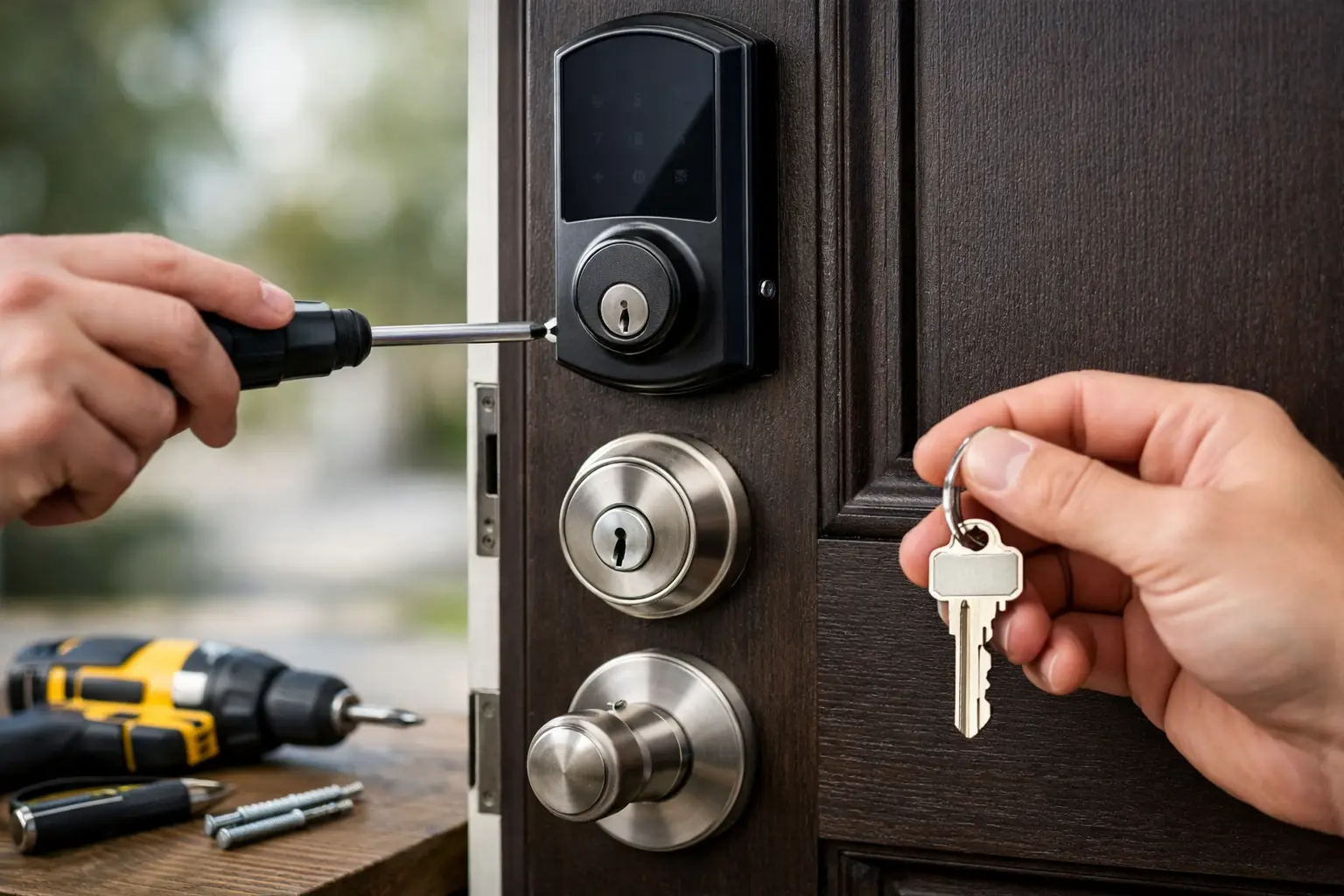
A front door can look solid while its lock, strike plate, or door frame leaves it vulnerable to forced entry. This home lock upgrade guide helps Montgomery County homeowners focus on the parts that make a real difference, from deadbolt construction to key control and professional installation.
A lock upgrade is not always about choosing the most complex hardware. The right solution depends on your door material, who needs access, the condition of the frame, and whether your current locks are worn, outdated, or compromised. A licensed locksmith can assess the full opening, not just the lock on the door.
Start With the Door and Frame, Not Just the Lock
A stronger lock cannot perform as intended if it is installed on a weak door or fastened to a thin, damaged frame. Before replacing hardware, inspect the complete entry point. Look for loose hinges, a door that shifts when closed, splintered wood around the latch, visible gaps, or a strike plate secured with short screws.
The strike plate is the metal piece mounted on the frame that receives the deadbolt. During a forced-entry attempt, this area takes substantial pressure. A reinforced strike plate secured with longer screws that reach the structural framing can improve resistance far more than a basic decorative plate.
Door alignment matters, too. If a deadbolt drags, requires lifting the door to lock, or only partially enters the strike, the issue may be hinge wear, frame movement, or a misaligned strike. Forcing the key or thumbturn can wear out the lock and eventually create a lockout. Correcting alignment protects the new hardware and makes daily use more reliable.
Home Lock Upgrade Guide: Choose the Right Deadbolt
For most exterior residential doors, a quality single-cylinder deadbolt is the foundation of a practical security upgrade. It uses a key from the outside and a thumbturn on the inside, allowing occupants to leave quickly without searching for a key. This configuration works well for many primary entry doors when the door does not have nearby glass that could allow someone to reach the thumbturn.
A double-cylinder deadbolt requires a key on both sides. It may be considered when glass panels or sidelights are close enough to the interior thumbturn to create an access concern. However, it also requires careful planning. Everyone in the home must know where the interior key is kept and be able to use it quickly during an emergency. Local building requirements and the door’s use should be reviewed before selecting this style.
Look for residential deadbolts tested to recognized ANSI/BHMA standards. Grade 1 hardware is generally intended for the highest level of residential and light commercial duty, while Grade 2 can be a dependable choice for many homes. The grade alone is not the entire answer, but it gives homeowners a useful way to compare durability and resistance to common forms of forced entry.
Avoid treating a latch lock in a knob or lever as the only protection on an exterior door. Latch locks provide convenience, but a properly installed deadbolt gives the door a more secure primary locking point.
Consider the Cylinder and Keyway
The cylinder is where the key enters, and its quality affects both reliability and resistance to manipulation. Standard keyways may be appropriate for some households, especially after a recent rekey. Homes that need tighter key control may benefit from restricted key systems, which make unauthorized duplication more difficult.
This can be particularly useful for landlords, property managers, households with frequent service access, or homeowners who have distributed spare keys over the years. The goal is not to make access inconvenient. It is to know who can enter and to have a clear way to regain control when circumstances change.
Rekey, Replace, or Upgrade?
Rekeying changes the internal configuration of an existing lock so old keys no longer work. It is often the right response after moving into a home, losing a key, ending a contractor relationship, or realizing too many copies may be in circulation. If the lock is in good condition and meets your needs, rekeying restores key control without replacing every piece of hardware.
Replacement makes more sense when the lock is damaged, outdated, difficult to operate, or paired with a weak deadbolt design. It is also appropriate when homeowners want to move from a basic lock to a higher-grade deadbolt, a restricted keyway, or electronic access.
An upgrade should include matching the lock to the door. A professional will verify backset, bore hole size, door thickness, handing, and compatibility with existing trim. These details prevent a new lock from being installed in a way that looks finished but binds, leaves gaps, or fails to engage fully.
When a Smart Lock Is the Better Fit
Smart locks can be useful for busy households, rental properties, and homeowners who want to issue temporary codes instead of handing out physical keys. They can reduce the need for spare keys and make it easier to remove access for a dog walker, cleaner, guest, or contractor when that access is no longer needed.
The trade-off is that smart locks require thoughtful setup and maintenance. Choose a model with dependable mechanical backup access, maintain fresh batteries, and test the lock after installation. Make sure the deadbolt moves freely before relying on the motor, because an alignment issue can strain the mechanism and shorten its service life.
Connectivity is another decision. Some homeowners prefer keypad models that operate locally, while others want app-based control and notifications. More features can be helpful, but they also create more settings to manage. Select functions your household will actually use, and protect any connected account with strong credentials.
A smart lock should not be viewed as a substitute for a sound door, reinforced strike, and properly operating deadbolt. It is an access-management tool first, and it performs best as part of a complete entry-door upgrade.
Get a Professional Lock Upgrade Assessment
Multi Locksmith LLC provides licensed, insured, and background-checked technicians for deadbolt upgrades, rekeying, and smart lock installation throughout Montgomery County.
📞 Call 240-706-4799Do Not Overlook Secondary Doors
Many homes have a well-secured front door but weaker side, garage-entry, basement, patio, or rear doors. These openings deserve the same assessment, especially if they are less visible from the street or are used less often.
For a door leading from an attached garage into the home, use dependable deadbolt hardware and confirm the door closes and latches correctly. Sliding patio doors may need a dedicated secondary lock or security bar in addition to their factory latch. French doors need special attention at the meeting point between doors, where hardware and reinforcement options vary by design.
Garage service doors, basement doors, and doors from a deck should not be treated as afterthoughts. A complete review identifies the weakest access point instead of concentrating all attention on the main entrance.
Know the Signs Your Locks Need Professional Attention
Some lock problems are obvious, such as a broken key, a lock that spins freely, or a deadbolt that will not extend. Others develop gradually. Sticking keys, loose exterior cylinders, a thumbturn that feels rough, recurring alignment problems, or doors that must be pushed hard to lock all deserve attention before they become an urgent issue.
Homeowners should also arrange service after a break-in attempt, even if the lock still appears functional. Damage to the strike, door edge, frame, or internal lock components may not be visible at first glance. A professional inspection can determine whether rekeying, repair, reinforcement, or replacement is the appropriate next step.
For households in Rockville, Silver Spring, Bethesda, Gaithersburg, and surrounding Montgomery County communities, a mobile locksmith can inspect the door on-site and recommend hardware based on the actual condition of the opening. Multi Locksmith LLC provides licensed, insured, and background-checked service for homeowners who need dependable lock repair, rekeying, deadbolt replacement, or smart lock installation.
Make the Upgrade Work for Your Household
Once new hardware is installed, give every household member a clear plan for entry and emergency exit. Decide where authorized spare keys belong, remove old keys from circulation, and avoid hiding keys in predictable outdoor locations. If you use keypad access, delete temporary codes promptly and keep mechanical backup keys available to trusted occupants.
Test each exterior door periodically. The deadbolt should extend fully without force, the key should turn smoothly, and the door should close without being lifted or pushed into position. Small adjustments made early can prevent a late-night lockout or a compromised entry point.
The most effective home security improvements are often practical ones: a correctly aligned door, a reinforced frame, a quality deadbolt, and controlled access. When your locks begin showing wear or your household’s access needs change, having a qualified locksmith evaluate the entire door can turn a basic repair into lasting protection.