
Access Control Versus Traditional Keys Compared
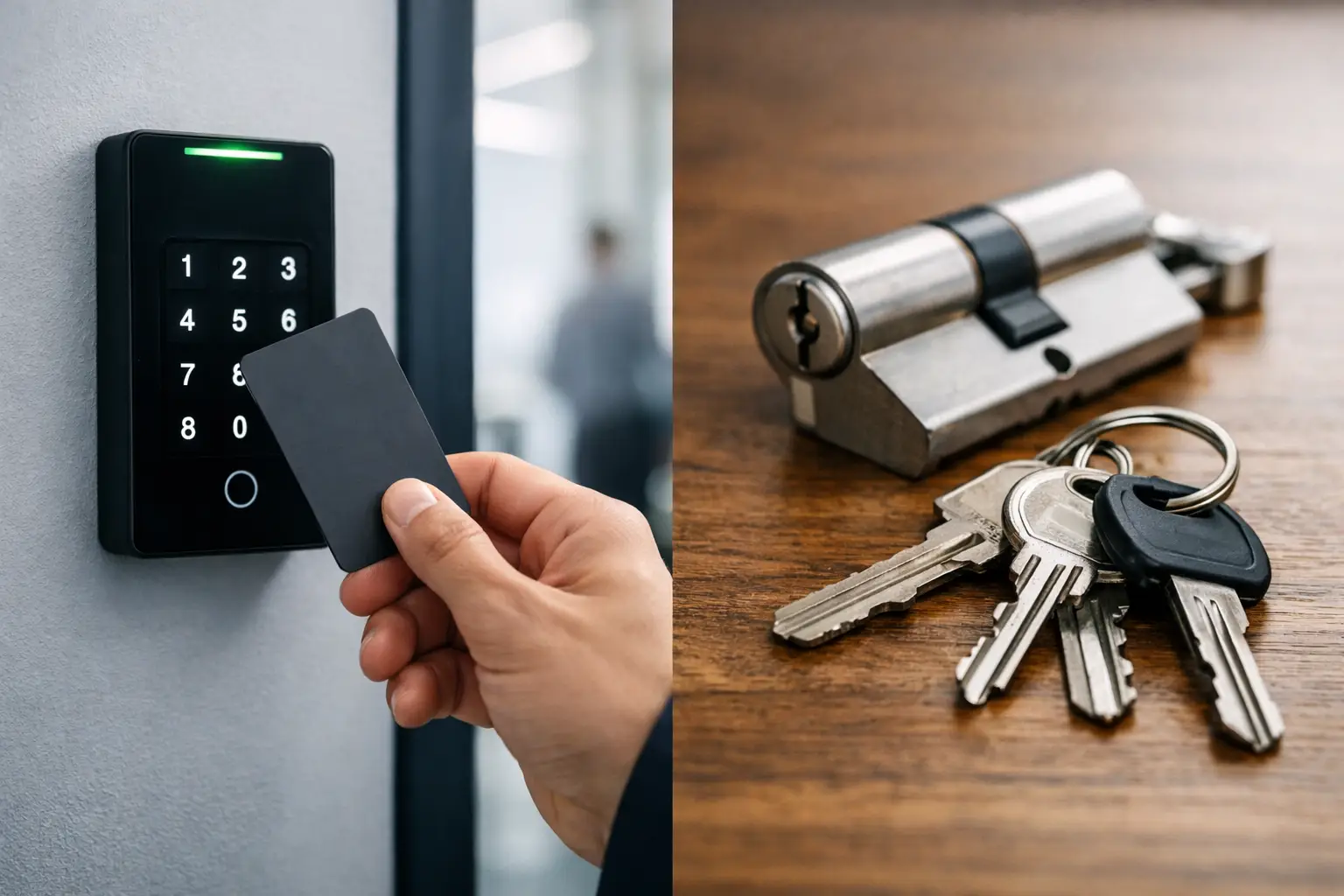
A missing office key can become a bigger problem than it first appears. If that key opened a rear entrance, storage room, or suite shared by several employees, a manager must decide whether to recover it, rekey the lock, or accept the uncertainty. That is where access control versus traditional keys becomes a practical security decision, not just a technology upgrade.
For Montgomery County homeowners and business operators, the right choice depends on who needs access, how often that access changes, and how much oversight the property requires. Traditional keys remain effective for many doors. Electronic access control offers more visibility and flexibility when a property has changing staff, multiple entry points, or stricter access requirements.
How Traditional Keys Work Best
Traditional keyed locks are familiar, dependable, and appropriate for many residential and small commercial applications. A properly installed deadbolt or commercial-grade lock gives the user a physical credential that works without batteries, software, or a network connection. For a homeowner with a few trusted occupants, that simplicity is often the point.
Keys also work well when access rarely changes. A small office with one exterior door, a stable team, and limited restricted areas may be well served by a quality lock and a controlled key-duplication plan. The hardware is straightforward, and a licensed locksmith can rekey the lock when a key is lost, a tenant moves out, or ownership changes.
Master Key Systems Add Convenience, Not Individual Tracking
For businesses with several doors, a master key system can create useful levels of access. An employee may have a key for their office and assigned areas, while a manager has a key that opens a larger group of doors. This can reduce the number of keys carried by staff and simplify daily operations.
However, a master key system still relies on physical keys. If a master key is lost, the impact can be significant because it may open multiple areas. Careful key control, documented issuance, and professional system design are essential. It is an effective mechanical solution, but it does not provide an entry record or remote changes.
What Access Control Changes
Electronic access control replaces or supplements a metal key with credentials such as key fobs, cards, mobile credentials, PIN codes, or biometric readers. A credential is presented to a reader, and the system determines whether that person is permitted to enter at that door and at that time.
The most valuable advantage is control after a credential leaves your hands. When an employee leaves, a manager can remove that person from the system instead of collecting every key and wondering whether copies exist. If a fob is lost, it can be deactivated while other authorized users continue using their credentials.
Access control can also create an activity record. Depending on the system and configuration, management may be able to see which credential was used at a particular entrance and when. This is especially helpful for offices, medical practices, multifamily properties, warehouses, and businesses with restricted rooms or changing shifts.
Time-Based Access Protects Daily Operations
Not every employee needs access at every hour. Access control can assign schedules so a cleaning crew, contractor, or part-time employee has entry only during approved periods. A business can also limit certain credentials to a single door while allowing managers access to additional areas.
That flexibility is difficult to achieve with standard keys alone. A physical key generally works whenever it is inserted into the matching lock. For properties with frequent staffing changes or several access levels, electronic credentials can reduce administrative burden and improve oversight.
Access Control Versus Traditional Keys: the Real Trade-Offs
Neither option is automatically better for every property. The best solution starts with the door, the people using it, and the consequences of unauthorized entry.
Traditional keys have fewer components and are easy for nearly anyone to use. They are often a strong fit for a private residence, a low-turnover office, mechanical closets, or secondary doors where the owner wants reliable physical security without credential management. Quality hardware, correct installation, and rekeying when circumstances change matter more than adding technology for its own sake.
Access control adds flexibility, but it requires proper planning. The lock hardware must match the door and frame, the door must close and latch correctly, and the system needs appropriate power and configuration. A poorly designed system can create daily frustrations, including doors that do not release correctly or credentials that are not assigned consistently. Professional installation is not just about mounting a reader. It is about making sure the door functions properly during normal operation and remains compliant with required exit hardware.
Electronic systems also need ongoing management. Someone must add and remove users, review access permissions, and maintain credentials. For a business that already has a responsible office manager or facilities contact, that is usually manageable. For a very small property with almost no staff changes, it may be more system than the situation requires.
Questions to Ask Before Choosing a System
- If only family members use one or two exterior doors, a high-quality deadbolt or professionally installed smart lock may provide the right level of convenience.
- If a rental property changes occupants often, rekeying between tenancies or using managed electronic credentials can prevent former occupants from retaining access.
- Do employees, vendors, cleaners, or contractors come and go regularly?
- Are there rooms containing records, inventory, equipment, or sensitive materials that should be limited to certain roles?
- Is there a need to know who entered after hours?
Consider the condition of the door as well. Access control cannot compensate for a weak frame, damaged closer, misaligned latch, or failing panic hardware. On commercial doors, the locking method, exit requirements, and fire-rated door components must work together. An on-site evaluation helps identify whether the priority is a new lock, door repair, a master key system, electronic access, or a combination of solutions.
A Practical Hybrid Approach for Many Properties
Many properties do not need to choose only one method. A business might use access control at main employee entrances and maintain traditional keyed locks on low-risk utility rooms. A homeowner may use a smart lock at the primary entry while keeping a conventional deadbolt on a side door. A property manager may use a master key system for maintenance access and electronic credentials for common areas.
This approach can place stronger control where it has the most value without complicating every door. It also gives property owners a clear way to improve security in phases as their staffing, occupancy, or building needs change.
When to Call a Professional Locksmith
A professional locksmith should assess more than the lock itself. The condition of the door, hinges, strike plate, frame, closer, and exit hardware all affect whether an entry point performs as intended. For commercial properties, credential convenience must never interfere with reliable egress.
Multi Locksmith LLC provides on-site support for businesses and property owners who need help evaluating keyed locks, master key systems, smart locks, access control, and panic hardware. Licensed, insured, and background-checked service matters when someone is working on the doors that protect your property.
If access has changed hands, a door is not operating correctly, or you are unsure who still has a key, treat that as a reason to review the system rather than a problem to postpone. The right security setup is the one your property can manage confidently every day.